Higher Education Lead Generation & Student Acquisition
Student leads aren’t the finish line. Enrollment is.
I have worked on SEO and PPC campaigns for colleges and universities since the earlier years of online student acquisition.
The technology has changed considerably since then. The business problem hasn’t.
A click is not a student. A website visit is not a student. Even a completed lead form is not necessarily a successful marketing outcome.
That distinction has shaped the way I approach digital marketing throughout my career.
In higher education, the conversion that ultimately matters is an enrolled student.
Higher-Education Search Marketing — With the Original Reports to Prove It
I’ve been around Internet marketing long enough that it is easy to make claims about what I was doing twenty years ago.
I’d rather show the work.
Some of my original higher-education SEO reports, PPC planning documents, campaign-performance reports and other materials survived.
An archived version of this Ad Web Designs page preserved a historical A.T. Still University search artifact with the caption: “Top 5 First Page Results Keywords: Medical Degree, Online Medical Degree – 100’s More.”
Those are unbranded, program-level searches. Other surviving reports document individual academic programs and degree-related queries across Google, Yahoo and MSN.
I don’t show twenty-year-old rankings because those positions have commercial value today. They don’t.
I show them because they’re evidence of the work.
How I Got Into Higher-Education Marketing
An important person in this story is Bob Barker.
Bob wasn’t simply someone who happened to start an education marketing company.
He spent approximately twenty years with the University of Phoenix organization. A 1999 Apollo Group annual report identifies him as a Regional Vice President, and later biographical accounts describe him as becoming a Senior Vice President of Apollo Group with responsibility for University of Phoenix campus operations across the United States, Canada and Mexico.
After leaving University of Phoenix, Bob founded Barker Educational Services Team, or BEST, to help colleges and universities develop and launch online degree programs.
That background matters.
Bob came from an organization operating student acquisition at enormous scale.
In 2007, University of Phoenix and Apollo Group reportedly spent approximately $278 million on advertising, most of it on the Web. The Washington Post reported that University of Phoenix had been the largest buyer of online display advertising in the United States during the preceding year.
That same year, Apollo acquired online advertising company Aptimus for approximately $48 million. Apollo said the acquisition would give it greater control over online marketing investments and improve the efficiency of student-inquiry and new-student enrollment efforts.
This was large-scale digital student acquisition before most businesses had figured out what digital acquisition was.
Sources: Apollo Group 1999 Annual Report; Robert Barker obituary/biographical account; The Washington Post, June 18, 2008; Apollo Group/Aptimus acquisition announcement filed with the SEC.
I Showed Up With About 100 Pages of SEO and PPC Work
I remember one of our conversations particularly well.
Bob told me about a major Midwestern university that had spent approximately $3 million over two years and, according to my recollection and surviving historical material, acquired only about 15 students.
That got my attention.
When I returned for a more formal meeting, I overprepared.
I showed up with what had to be at least 100 pages of examples of SEO and PPC campaigns I had created.
I was hired on the spot.
That story probably explains my philosophy better than a paragraph of marketing copy ever could.
Show the work.
Fortunately, some of it survived.
Business Wire Documented My Hiring
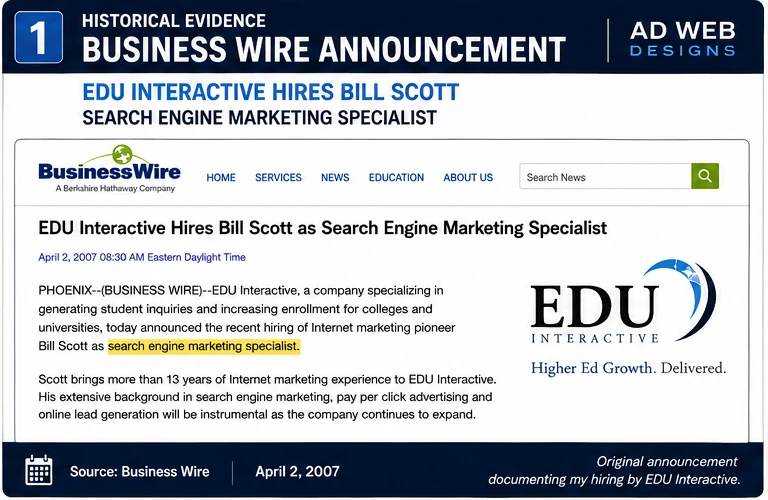
A Business Wire announcement dated April 2, 2007 documented my hiring by EDU Interactive as a Search Engine Marketing Specialist.
The announcement described EDU Interactive as a company specializing in generating student inquiries and increasing enrollment for colleges and universities. It described me at the time as an Internet marketing pioneer with more than 13 years of experience.
I don’t claim that every college or university associated with EDU Interactive was personally my account.
I don’t need to.
What I can document is that I performed SEO and PPC work for colleges and universities inside an organization built specifically around higher-education student acquisition.
Program-Level SEO, Not Just University Rankings
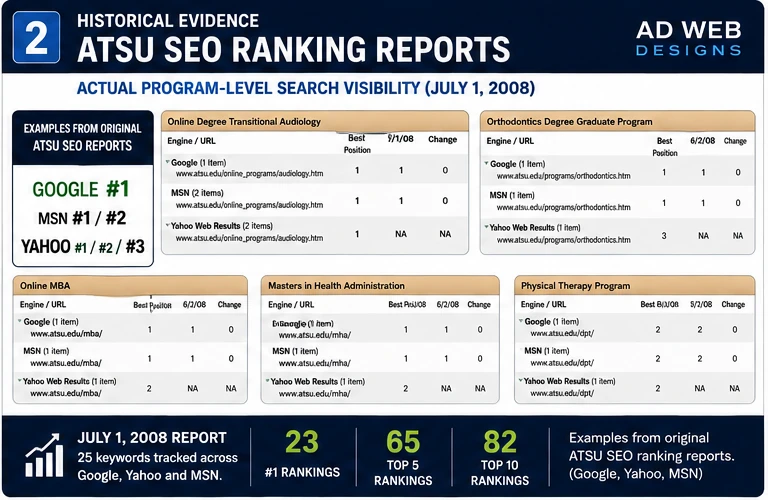
The surviving A.T. Still University reports are particularly valuable because they show what the work actually looked like.
These weren’t simply reports showing that a university ranked for its own name.
They tracked searches associated with individual degrees and academic programs.
- Medical Degree
- Online Medical Degree
- Online Degree Transitional Audiology
- Orthodontics Degree Graduate Program
- Online Degree Human Movement
- Certified athletic training Degree
- Audiology Degree Program
- Biomedical Sciences Degree programs
- Dental Degree programs
Among the surviving ranking examples:
Online Degree Transitional Audiology — Google #1
Orthodontics Degree Graduate Program — Google #1
Online Degree Human Movement — Google #2
Certified athletic training Degree — Google #2
The archived Ad Web Designs page also specifically described Medical Degree and Online Medical Degree as Top 5 first-page results.
The important point isn’t that a particular ranking existed on a particular day twenty years ago.
It’s what the reports reveal about the strategy.
We were targeting program-level prospective-student intent.
Today people talk about entities, topical authority, intent architecture and connecting university-level authority to individual program pages.
The terminology has evolved.
The underlying problem is very familiar.
And yes, I was doing this when SEO reports still contained columns for Google, Yahoo and MSN.
SEO and PPC Were Part of the Same Student-Acquisition System
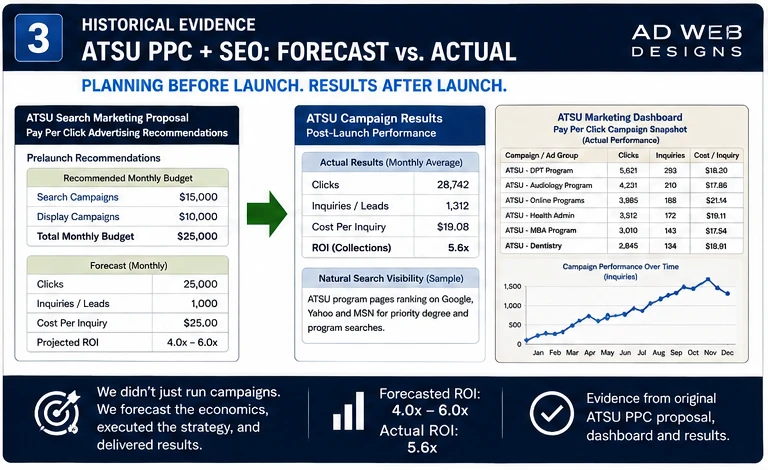
The surviving material isn’t limited to SEO.
I also have historical PPC proposals, budget recommendations, campaign reports and performance material associated with higher-education marketing.
This is important because I didn’t view PPC as simply buying clicks.
Before spending the money, establish expectations.
After spending it, compare those expectations with reality.
Then keep following the prospect downstream.
The software is ancient.
The discipline isn’t.
We Were Measuring Beyond the Form Fill
Higher education forces you to confront something marketers sometimes prefer not to confront:
The lead isn’t the sale.
That changes how marketing performance should be judged.
A campaign producing inexpensive leads can be terrible if those prospects don’t progress.
A campaign with a higher cost per inquiry can be considerably more valuable if those students are qualified, answer the phone, speak with admissions, apply and enroll.
A click isn’t a student. A form isn’t an enrollment.
Quality Over Quantity
I have historical higher-education industry correspondence that illustrates how seriously marketers were already thinking about downstream lead quality.
One organization representing seven private post-secondary education brands across 36 campuses discussed lead payouts in the neighborhood of $20–$40, appointment rates around 25 percent and enrollment conversion around 4 percent.
But the most important words in the correspondence weren’t numbers.
That remains the right idea.
Ten thousand inquiries aren’t automatically better than one thousand.
- Who was qualified?
- Who was contacted?
- Who spoke with admissions?
- Who applied?
- Who enrolled?
- What did that enrollment cost?
- Did the economics work for the institution?
The Higher-Education Funnel I Actually Care About
↓
University or Program Website
↓
Student Inquiry
↓
Qualified Prospect
↓
Admissions Contact
↓
Application
↓
Enrollment
↓
Student Start
Every stage gives us information.
Cost per click is useful. Cost per lead is useful. Conversion rate is useful.
But those are diagnostic and operational metrics.
Cost per enrolled student gets much closer to the business outcome.
PPC for Colleges and Universities
A person searching a university’s name is different from someone searching for a degree.
Someone searching for an online medical degree has different intent from someone searching for an MBA.
Someone searching for tuition information may be at another stage entirely.
Campaign architecture should recognize those differences.
And then the advertising data has to connect to what happens after the click.
Modern advertising platforms are enormously more sophisticated than the systems I used in 2007.
But sophisticated automation doesn’t fix bad measurement.
If we tell Google that every lead is equally valuable, we shouldn’t be surprised when it finds more leads instead of more valuable students.
SEO for Colleges and Universities Has Changed — and Expanded
Prospective students still search for universities, degrees, programs, tuition, admissions requirements, accreditation, faculty, career outcomes and answers to specific questions.
But search engines now understand substantially more about the entities and relationships behind those pages.
A university is an entity. So is its medical school. So is its business school. So is a department. So is a degree. So is an individual program. So is a campus. So is a faculty member. So is an accrediting organization. And so is the profession associated with a degree.
When those relationships are poorly defined online, search engines and AI systems have to infer them.
I would rather define them.
Students Now Have Another Discovery Layer: AI
This is the part that has changed dramatically.
A prospective student no longer has to conduct ten separate Google searches and visit ten university websites before beginning to compare programs.
The student can ask:
Which universities offer accredited audiology programs?
What are the best online MBA programs for someone working full time?
Which schools offer online healthcare administration master’s degrees?
Which programs can I complete without relocating?
Compare these three programs for me.
Which university would you recommend for my situation?
That means universities aren’t competing only to rank.
They’re increasingly competing to be understood, compared, cited and recommended.
AI Systems Need to Understand the Institution Before They Can Recommend It
This is where entity definition becomes critical.
The institution needs to be connected clearly to its schools. Schools to departments. Departments to programs. Programs to degrees. Programs to faculty. Programs to delivery formats. Programs to admissions requirements. Programs to accreditation. Programs to tuition. Programs to career outcomes.
Those relationships also need to remain reasonably consistent throughout the wider digital ecosystem.
This isn’t about putting the phrase AI optimization on every page.
It’s about making the institution understandable.
AI Visibility Isn’t an Enrollment Either
AI introduces another potential marketing trap.
An AI citation is interesting. An AI mention can be valuable. An AI recommendation could become extremely valuable.
But none of them is an enrollment.
Otherwise, we’re just celebrating a newer version of impressions.
Knowledge Respects Knowledge
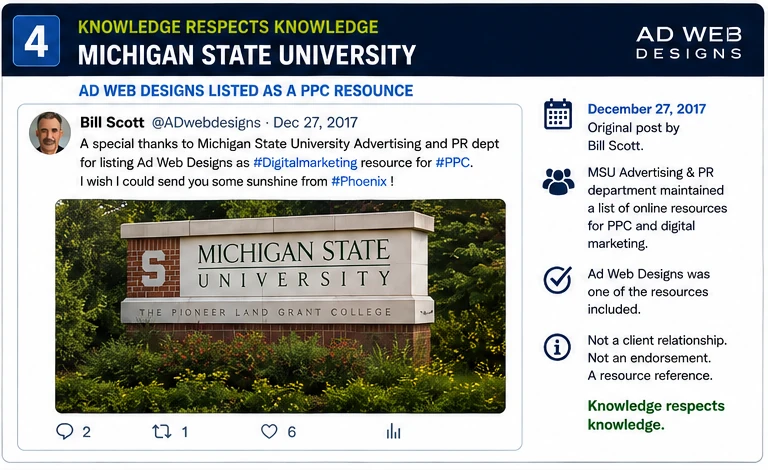
In 2017, I discovered that Michigan State University’s Advertising and Public Relations department had included Ad Web Designs among its online PPC and digital-marketing resources.
It wasn’t a client relationship.
Ad Web Designs wasn’t the only resource.
And I don’t present it as an endorsement.
Someone responsible for teaching or communicating about advertising found something I had created useful enough to share with other people.
I appreciated it then, and I still do.
The Ad Web Designs website has been rebuilt several times since 2017, so the website Michigan State referenced isn’t the same version you’re looking at today.
Fortunately, I saved the original post documenting the reference.
What I Would Want to Know Before Spending Another Dollar on Student Acquisition
Before increasing an institution’s SEO, PPC or AI-search investment, I want to understand the business problem.
- Which programs need students?
- Which have capacity?
- Where can those students realistically come from?
- What is an enrollment worth by program?
- What acquisition cost can the institution sustain?
- Which searches demonstrate meaningful student intent?
- How quickly does admissions respond?
- What percentage of inquiries are contacted?
- What percentage become applications?
- What percentage enroll?
- Where does attribution stop?
- Which programs are profitable to promote?
- Can Google, ChatGPT, Gemini and other discovery systems accurately understand the institution and its programs?
Those answers should influence the channels. Not the other way around.
The Platforms Changed. The Business Question Didn’t.
Years ago my reports contained:
Google. Yahoo. MSN.
Today we’re dealing with:
Google Search. YouTube. Paid Search. Organic Search. Social Platforms. AI Overviews. ChatGPT. Gemini. AI recommendation systems.
The interfaces changed. The algorithms changed. The devices changed. Measurement changed. The number of places where prospective students can discover an institution exploded.
But the underlying business question is remarkably familiar:
That’s the problem worth solving.
About Bill Scott and Ad Web Designs
I’m Bill Scott, owner of Ad Web Designs.
Ad Web Designs was established in 1996.
My career spans the early commercial Internet through SEO, paid search, analytics, conversion optimization and today’s AI-driven discovery and recommendation environment.
My historical higher-education experience includes serving as a Search Engine Marketing Specialist with EDU Interactive and performing SEO and PPC work for colleges and universities.
Some of the platforms I used no longer exist.
Some of the search engines barely exist.
Fortunately, some of the work survived.
That’s why this page doesn’t just tell you what I know.
It shows you where some of that knowledge came from.
Original reports. Original screenshots. Contemporaneous third-party documentation. Actual search campaigns. Actual higher-education experience.
I don’t expect you to believe a claim simply because I put it on my website. I’d rather show you the work.
Find My Opportunity
If your institution is trying to understand how SEO, PPC, AI discovery, entity definition and student acquisition fit together, start with the business problem.
